
Commercial Insights for Industrial Distribution: Margin Drivers and Demand Signals





Commercial insights are becoming the real margin map in industrial distribution
Industrial distribution is no longer shaped by volume alone. Margin now moves with timing, product mix, compliance friction, and the speed of demand interpretation.
That is why commercial insights matter more than broad market headlines. They help decode where pricing power is holding, where discounting is spreading, and where demand is quietly changing shape.
In tools, welding, metrology, and hydraulic equipment, the most useful signals often emerge at the last mile of manufacturing. Order patterns, service calls, calibration cycles, and replacement rates tell a fuller story than shipment totals.
This is also where GPTWM has built relevance. Its Strategic Intelligence Center tracks raw material swings, export standard shifts, tool technology limits, and evolving application demand with a level of industrial detail that supports real commercial judgment.
From recent market behavior, the central question is no longer whether demand exists. The question is which demand still protects margin, and which demand only adds turnover without improving profit quality.
The market is not simply slowing or expanding; it is fragmenting
A broad industrial rebound has remained uneven. Construction maintenance, automotive service, aerospace repair, and light fabrication are moving at different speeds across regions and categories.
That fragmentation is changing how commercial insights should be read. Average demand figures hide sharper shifts in attachment sales, consumables turnover, and premium tool acceptance.
More noticeable is the split between replacement demand and capability-upgrade demand. The first is cautious and price-sensitive. The second is selective, but still willing to pay for precision, safety, traceability, and labor savings.
In metrology, for example, demand is increasingly linked to tighter tolerance control and documented quality assurance. In welding, adoption is being influenced by safety requirements, operator efficiency, and process consistency.
This means commercial insights must separate temporary restocking from structural demand. Confusing the two can distort inventory planning and lead to avoidable margin erosion.
Several signals are now more useful than headline sales
- Growing inquiry volume for calibrated measuring instruments with documentation requirements.
- Faster movement in repair, retrofit, and maintenance-related welding equipment.
- Higher sensitivity to lead times on brushless power tools and hydraulic assemblies.
- More requests tied to export compliance, operator safety, and standard alignment.
Each of these signals points to more than immediate sales activity. They reveal where end users are protecting uptime, reducing labor risk, and defending quality under tighter operating conditions.
Why these shifts are becoming more visible now
The underlying drivers are both cyclical and structural. Input costs have been volatile, but customer expectations have also changed in ways that are less reversible.
Raw material fluctuations continue to affect pricing discipline. Even when steel or component costs stabilize, channel pricing does not immediately normalize because buyers have become more alert to replacement timing and specification flexibility.
At the same time, labor availability is reshaping equipment preference. Products that shorten setup time, reduce rework, or support safer handheld operation can hold premium positioning more effectively than standard models.
Export restrictions and standard updates are another pressure point. They do not just create compliance work. They change product eligibility, documentation requirements, and service expectations across distribution networks.
GPTWM has been especially relevant in this area because its commercial insights connect technical evolution with market consequences. That linkage is often where pricing decisions become clearer.
The strongest demand signals are coming from precision, uptime, and controllable risk
Not every industrial category is receiving the same kind of attention. Commercial insights increasingly show that capital is moving toward areas where operational outcomes can be measured and defended.
High-precision measuring instruments remain a notable example. Demand is not only linked to inspection activity. It is tied to certification, repeatability, and the need to reduce downstream quality losses.
Hydraulic equipment shows a different pattern. Here, the pull often comes from harsh-duty applications where failure costs are immediate and visible. Reliability matters more than simple unit price comparisons.
In welding, handheld laser systems have drawn attention because they combine productivity with a new layer of safety requirements. Adoption rises fastest where training, shielding, and process controls are treated as part of the offer.
Power tools are also seeing a subtle shift. Buyers are asking tougher questions about brushless motor limits, battery consistency, thermal behavior, and field-life economics. That changes how premium claims must be supported.
Across all these categories, commercial insights are most useful when they connect technical specifications to actual willingness to pay.
Impact is spreading across pricing, inventory, and channel positioning
The practical impact is wider than product selection. Margin pressure now appears earlier in the sales cycle, often through quotation behavior, bundle expectations, and service inclusions.
Inventory planning has become more delicate. Stocking broad assortments without a clear demand thesis can trap working capital in slow-moving references, while missing key calibrated or compliance-ready items can delay high-value orders.
Channel positioning is changing as well. Distributors that translate technical complexity into commercial clarity are gaining stronger brand premiums than those competing mainly on availability.
That is one reason intelligence-led platforms matter. GPTWM’s coverage of assembly, joining, and metrology helps bridge technical change with distribution economics, which is often where strategic decisions stall.
Where margin is usually won or lost
- Specifying too low for the application and absorbing performance complaints later.
- Holding the wrong stock depth in categories affected by standard or safety updates.
- Treating service, calibration, and training as optional instead of value-bearing components.
- Using historical demand averages when end-use sectors are diverging sharply.
The better response is not more data, but sharper commercial insights
In practice, better decisions come from ranking signals rather than collecting endless information. The most effective commercial insights are specific enough to change action.
A useful starting point is to separate demand into three layers: continuity demand, compliance-driven demand, and capability-upgrade demand. Each layer deserves a different pricing and stocking logic.
Continuity demand supports baseline revenue, but often faces price competition. Compliance-driven demand can preserve margin when documentation, approved sourcing, or traceability cannot be compromised.
Capability-upgrade demand is usually smaller in volume, yet more strategic. It tends to favor solutions that improve productivity, precision, or safety in measurable ways.
This layered view also helps interpret mixed signals. A weak quarter in commodity categories does not automatically mean weakening conditions in higher-specification industrial segments.
Useful next checks for the coming quarters
- Track which quotations are delayed by approval or standard questions rather than price alone.
- Measure sell-through by application cluster, not just by product family.
- Review whether service, calibration, and safety support are helping protect gross margin.
- Compare replacement demand with upgrade demand to avoid reading short-term restocking as long-term growth.
- Watch sectors where aerospace maintenance, automotive repair, and infrastructure work are shifting tool requirements.
What deserves closer attention from here
The next phase of industrial distribution will reward interpretation more than scale alone. Commercial insights will be central to reading margin drivers before they become visible in reported averages.
The most important signals are already visible: stronger scrutiny on specifications, rising value on safety and traceability, and selective demand for equipment that improves uptime and precision.
That creates a practical agenda. Reassess where profit is truly generated, compare demand quality across categories, and monitor which technical changes are beginning to alter buying behavior.
Commercial insights are most valuable when they lead to staged action. Build a review cadence around pricing exposure, compliance-sensitive inventory, and application-level demand shifts.
A market like this does not reward passive observation. It rewards disciplined signal reading, better category judgment, and a clearer link between industrial change and commercial response.
Related News

Selecting Adjustable Torque Tools for Repeatable Fastener Assembly
Adjustable torque tools: learn how to match range, accuracy, control methods, calibration, and ergonomics for repeatable, reliable fastener assembly.

How to Select Aerospace Inspection Tools for Aircraft Maintenance Tasks
Aerospace maintenance inspection tools: learn how to select reliable, traceable equipment for aircraft access, accuracy, calibration, and compliant maintenance decisions.

How to Select Wire Bonding Tools for Fine-Pitch Semiconductor Packaging
Explore semiconductor manufacturing tools for wire bonding and learn how to select precision solutions for fine-pitch packaging, reliable loops, accuracy, and yield.
How to Compare Industrial Tool Suppliers for Quality, Lead Time, and Total Cost
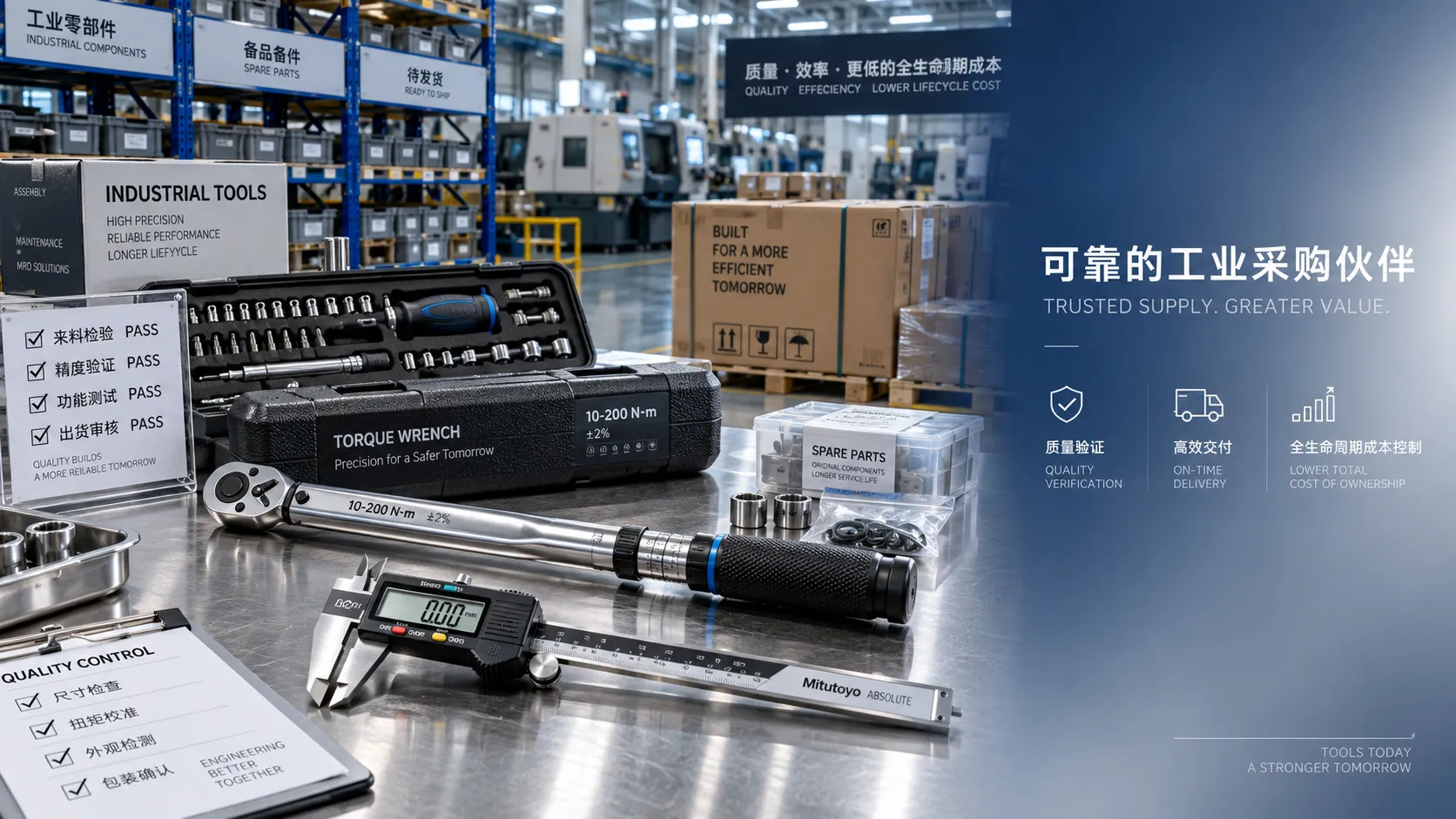
Industrial tool selection supplier comparison made simple: evaluate quality, lead times, total cost, service, and supply resilience for confident sourcing decisions.

Industrial Equipment Application Guidance: Match Machines to Operating Conditions
Application guidance industrial equipment: match capacity, duty cycle, materials, site conditions, safety, and lifecycle cost to improve reliable output. Read the guide.

Selecting High-Speed Brushless Tool Motors for Torque, Heat, and Duty Cycle
High speed brushless tool motors: learn how to balance torque, heat, gearing, and duty cycle for reliable industrial tool performance and longer service life.

What Determines Industrial Hydraulic System Price for Heavy-Duty Equipment?
Industrial hydraulic system price depends on duty cycle, pressure, components, cooling, and integration. Compare quotes intelligently to secure reliable heavy-duty performance.

Welding Fume Extraction PPE: When Respirators Are Not Enough for Shop Safety
Welding fume extraction PPE: learn why respirators alone fall short and how source capture, ventilation, and layered controls improve shop safety.

How to Select Optical Metrology Solutions for Tight-Tolerance Manufacturing
Optical industrial metrology solutions for tight-tolerance manufacturing: evaluate accuracy, surface compatibility, workflow, and traceability to select with confidence.
Related News
- 00
0000-00
How Procurement Teams Can Map the Industrial Value Chain to Reduce Supply Risk - 00
0000-00
How Industry Category Guides Help Global Sourcing Teams Compare Suppliers Faster - 00
0000-00
Intelligent Tools in Southeast Asia: Key Market Trends, Buyers, and Supply Chain Shifts - 00
0000-00
Industrial Value Chain Europe: Where Sourcing Risks and Lead-Time Pressure Are Rising - 00
0000-00
North America's Industrial Value Chain: Key Shifts in Sourcing, Labor, and Logistics
Dr. Alistair Vaughn
Weekly Insights
Stay ahead with our curated technology reports delivered every Monday.