
Which Industrial Standards Should Be Checked Before Export?





Which Industrial Standards Should Be Checked Before Export?
Which industrial standards should be checked before export? For manufacturers of precision tools, welding equipment, powered assembly tools, and metrology products, this is not a paperwork question. It is a market-access question that can affect customs clearance, installation approval, distributor acceptance, product liability exposure, and the buyer’s confidence in the supplier.
The difficult part is that there is no single “international certificate” that makes an industrial product export-ready everywhere. A handheld laser welder, a digital caliper, a hydraulic puller, and a cordless torque tool can all be sold into the same country while falling under very different regulatory and technical requirements. The right starting point is not the product name printed on a carton. It is the product’s actual function, energy source, intended user, installation environment, and destination market.
Export compliance is most reliable when it is treated as a design and commercial-control process rather than a final inspection step. By the time goods are packed, a missing safety test, an incorrect power plug, or an unsupported declaration can be expensive to correct.
Start with the destination market, not a generic certificate list
The first distinction is between mandatory legal requirements, standards used to demonstrate conformity, and voluntary certifications requested by customers. These categories often overlap, but they are not identical.
In the European Economic Area, many product categories require CE marking before being placed on the market. The applicable legislation may cover electrical safety, electromagnetic compatibility, machinery-related risks, hazardous substances, radio equipment, or pressure-related hazards. CE marking is not a universal third-party certificate, and it does not mean that every product has been independently approved by a notified body. Depending on the product and applicable legislation, the manufacturer may be responsible for conformity assessment, technical documentation, risk analysis, and an EU Declaration of Conformity.
In the United States, buyers and authorities may focus on a different combination of requirements. For electrical industrial equipment, an OSHA-recognized Nationally Recognized Testing Laboratory mark is commonly expected in many workplace settings, even when a manufacturer assumes that general CE documentation will be sufficient. Products with electronic controls may also raise electromagnetic compatibility questions, while wireless-enabled equipment can trigger radio approval obligations. Canada, the United Kingdom, Japan, Australia, Gulf markets, and Latin American countries each have their own frameworks, marks, local registration routes, or importer responsibilities.
A distributor’s request should therefore be examined carefully. “CE required” may be a useful shorthand, but it is not a complete compliance instruction. Ask which country will receive the product, whether it will be resold or integrated into a larger machine, whether it is for professional or consumer use, and whether the buyer needs a legally required mark, a test report, or a named certification body’s listing.
Build the check around actual product risks
A practical export review begins with a product classification sheet. It should identify voltage and frequency, AC or DC supply, battery type, laser source, radio module, hydraulic or pneumatic pressure, moving parts, measured parameters, intended environment, and whether the product is supplied as a standalone unit or a system. This technical map makes it easier to identify the standards that matter.
For electrically powered tools and assembly equipment, electrical shock, overheating, insulation integrity, ingress protection, mechanical guarding, vibration, noise, and electromagnetic compatibility are recurring issues. Relevant IEC or EN standards may provide a recognized testing route, but the exact standard series and edition must match the product type. A corded industrial tool, a battery-powered fastening tool, and an electronically controlled torque system do not necessarily follow the same requirements.
Welding equipment requires closer attention because the hazards are layered. Arc welding power sources, wire feeders, torches, cooling units, fume extraction interfaces, and automated cells may each introduce separate obligations. IEC 60974 is widely associated with arc welding equipment, yet using the series name alone is not enough. Exporters need to determine which part applies to the specific equipment, whether accessories are included in the assessed configuration, and whether local electrical installation rules create additional requirements.
Handheld laser welding deserves a separate review. Laser classification, protective housing, interlocks, warning labels, operating instructions, personal protective equipment guidance, and safeguarding of the work area all need to be considered. Standards such as IEC 60825 address laser product safety, while laser processing machinery can involve additional requirements depending on the system design and intended use. A supplier should not treat a laser source certificate as proof that the completed welding system is compliant. Integration changes the risk profile.
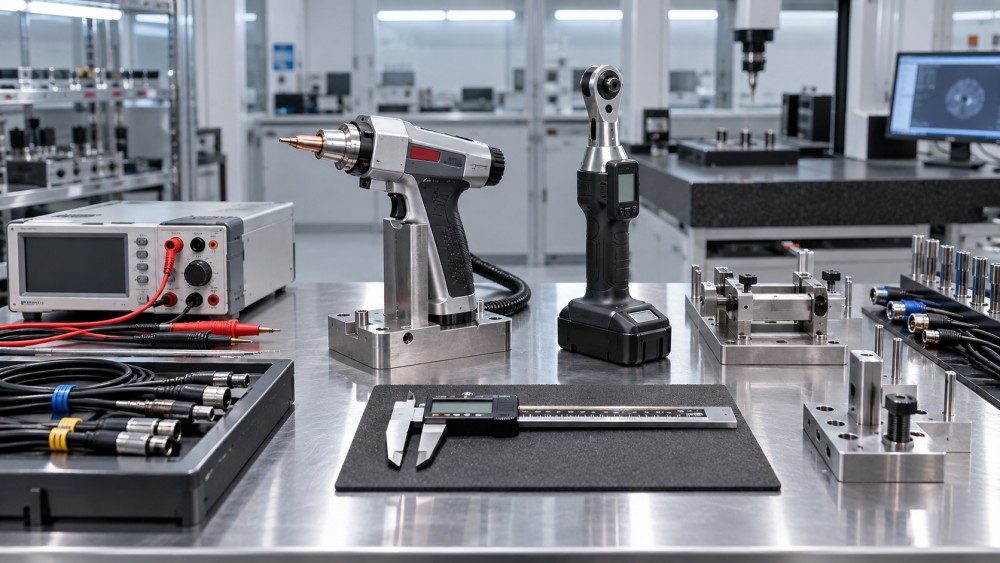
Metrology products create a different set of questions. A digital caliper, micrometer, torque tester, or industrial measuring system may need electrical and electromagnetic checks if it contains electronics, but performance claims also need evidence. Accuracy, repeatability, resolution, environmental operating limits, and calibration traceability should be stated in a way that can be supported. If calibration certificates are supplied, buyers may ask whether the calibration was performed by a laboratory operating to ISO/IEC 17025. That standard concerns laboratory competence; it is not a product certification and should not be presented as one.
Material compliance is often found too late
Material declarations can delay an otherwise well-prepared shipment. In many markets, restrictions on substances in electrical and electronic equipment, chemical disclosure rules, and requirements concerning substances of concern need to be assessed alongside the product-safety file. For products entering the EU, RoHS and REACH are frequently part of the review for applicable products and materials. They are not interchangeable: one addresses restricted substances in specified electrical and electronic equipment, while the other has a broader chemicals-management structure.
The challenge is rarely solved by asking a supplier for a vague “compliance certificate.” Manufacturers need material information from component suppliers, particularly for cables, coatings, plastics, solder, batteries, electronic assemblies, lubricants, and surface treatments. A defensible file links declarations and, where appropriate, test evidence to the bill of materials. If a component changes, the compliance assessment may need to change with it.
Packaging should also be reviewed. Export packaging is more than transit protection. Markings, recycling obligations, timber packaging rules, battery shipping labels, and dangerous-goods documentation may apply depending on the route and contents. Lithium batteries, for example, bring transport requirements that are separate from the electrical safety assessment of the finished tool. A battery-powered product can be safe to operate and still be improperly prepared for air or sea freight.
Documentation is part of the product
When an importer, customs authority, insurer, or industrial buyer asks for proof, a logo on the rating plate will not answer every question. The document package should be designed for the specific product family and market. It commonly includes a product description, risk assessment, applicable legal and standards list, test reports, drawings or critical-component information, labels, instructions, declarations, and records showing production consistency.
Instructions deserve more respect than they usually receive. They must reflect the delivered configuration, language requirements, foreseeable misuse, maintenance needs, residual risks, and the competence expected from users. A warning copied from a similar model may become misleading if the export version has a different voltage, guard, battery pack, laser power, or software function.
Labeling must be equally disciplined. Product identification, model number, serial or batch traceability, electrical ratings, manufacturer or responsible economic operator details where required, warning symbols, and conformity marks should be checked against the relevant market rules. Marks should never be applied merely because a buyer expects to see them. Incorrect marking can be more damaging than an honest discussion about what still needs verification.
Do not confuse quality management with product conformity
ISO 9001 can help demonstrate that a manufacturer operates a structured quality-management system. It does not automatically establish that a specific welding machine, torque wrench, or measuring instrument meets the laws and technical standards of an export market. The same caution applies to factory audit reports, supplier declarations, and prior test reports from another model.
This distinction matters especially when products are customized. A distributor may request a new plug, a higher-capacity battery, modified firmware, a branded enclosure, or a different control module. Those changes can affect safety, EMC behavior, radio approval, temperature rise, or the validity of earlier testing. “Same platform” is not always enough. The manufacturer needs a documented engineering judgment about whether the change remains within the evidence already held.
A workable pre-export review
Before confirming delivery, an exporter should be able to answer a few direct questions:
- What is the destination country and who is the legal importer or responsible party?
- What hazards and functions define the product: electrical, mechanical, laser, pressure, battery, radio, or measurement?
- Which mandatory regulations apply, and which technical standards are being used as the conformity route?
- Does the evidence cover the exact model, accessories, firmware, voltage, and components being shipped?
- Are labeling, manuals, declarations, calibration records, and transport documents complete for that market?
This review is not bureaucracy for its own sake. It prevents commercial teams from promising a market-ready product while engineering, compliance, and logistics are working from different assumptions.
At the Global Precision Tools & Welding Matrix, export standards are best understood as moving industrial intelligence rather than a static checklist. Requirements evolve with product electrification, intelligent torque control, brushless motor systems, laser processing, connected devices, and changing material expectations. Tracking those changes matters most at the manufacturing “last mile,” where a technically capable product must still arrive with the evidence needed to be installed, used, serviced, and trusted.
The soundest next step is to create a destination-specific compliance matrix before samples, quotations, or production commitments are finalized. Match each model and configuration to its target market, then verify the current legal route and applicable standard editions with competent testing, regulatory, or legal resources where necessary. That discipline is far more useful than collecting certificates after the shipment is already on the dock.
Related News
How to Select High-Precision Measuring Instruments for Tight-Tolerance Production?
High-precision measuring instruments are essential for tight-tolerance production. Learn how to evaluate accuracy, repeatability, environment, calibration, and data integration.
How Industrial Innovation Supplier Networks Reduce Sourcing Risk for Manufacturers
industrial innovation supplier network insights help manufacturers reduce sourcing risk, control lifecycle costs, and choose reliable tools, services, and suppliers with confidence.
What Industrial Automation Exporters Need to Know Before Entering ASEAN Markets
Industrial automation exporter to ASEAN: learn how to navigate compliance, local service, digital readiness, pricing, and market entry for scalable growth.

Prototype PCB Manufacturing Equipment: What Engineers Should Evaluate Before Purchase
Prototype PCB manufacturing equipment: discover the key factors engineers should evaluate—from accuracy and materials to software, safety, and ROI—before buying.

Workplace Ergonomics for Manufacturing: Reducing Repetitive-Strain Risks on Assembly Lines
Workplace ergonomics for manufacturing helps reduce repetitive-strain risks on assembly lines through smarter workstation design, tool selection, task analysis, and quality-focused improvements.
Selecting Adjustable Torque Tools for Repeatable Fastener Assembly
Adjustable torque tools: learn how to match range, accuracy, control methods, calibration, and ergonomics for repeatable, reliable fastener assembly.

How to Select Aerospace Inspection Tools for Aircraft Maintenance Tasks
Aerospace maintenance inspection tools: learn how to select reliable, traceable equipment for aircraft access, accuracy, calibration, and compliant maintenance decisions.

How to Select Wire Bonding Tools for Fine-Pitch Semiconductor Packaging
Explore semiconductor manufacturing tools for wire bonding and learn how to select precision solutions for fine-pitch packaging, reliable loops, accuracy, and yield.
How to Compare Industrial Tool Suppliers for Quality, Lead Time, and Total Cost
Industrial tool selection supplier comparison made simple: evaluate quality, lead times, total cost, service, and supply resilience for confident sourcing decisions.
Related News
- 00
0000-00
How Industrial Innovation Supplier Networks Reduce Sourcing Risk for Manufacturers - 00
0000-00
Which Industrial Standards Should Be Checked Before Export? - 00
0000-00
What Industrial Automation Exporters Need to Know Before Entering ASEAN Markets - 00
0000-00
How Procurement Teams Can Map the Industrial Value Chain to Reduce Supply Risk - 00
0000-00
How Industry Category Guides Help Global Sourcing Teams Compare Suppliers Faster
Dr. Alistair Vaughn
Weekly Insights
Stay ahead with our curated technology reports delivered every Monday.