
What Maintenance Do Digital Factory Monitoring Systems Need?





A digital factory monitoring system is often treated as a software project: install sensors, connect machines, build dashboards, and start reviewing alerts. In practice, that is only the beginning. The system becomes useful over time only if its measurements remain trustworthy, its connections stay stable, and its users know which alarms deserve action.
So, what maintenance is needed for digital factory monitoring systems? The short answer is a mix of physical inspection, calibration control, network management, software upkeep, cybersecurity, and routine review of the data itself. The balance depends on whether the system is tracking welding parameters, tool torque, machine vibration, energy consumption, dimensional inspection, environmental conditions, or production flow. A temperature sensor above a welding cell does not have the same maintenance profile as a connected torque controller on a final assembly line.
The important distinction is this: maintaining the digital monitoring platform is not the same as maintaining the production equipment it observes. A machine may still run while the monitoring layer quietly reports incorrect cycle times, missing torque traces, or false “normal” readings. That is why digital maintenance needs its own ownership, records, and escalation path.
A monitoring system has more failure points than a dashboard suggests
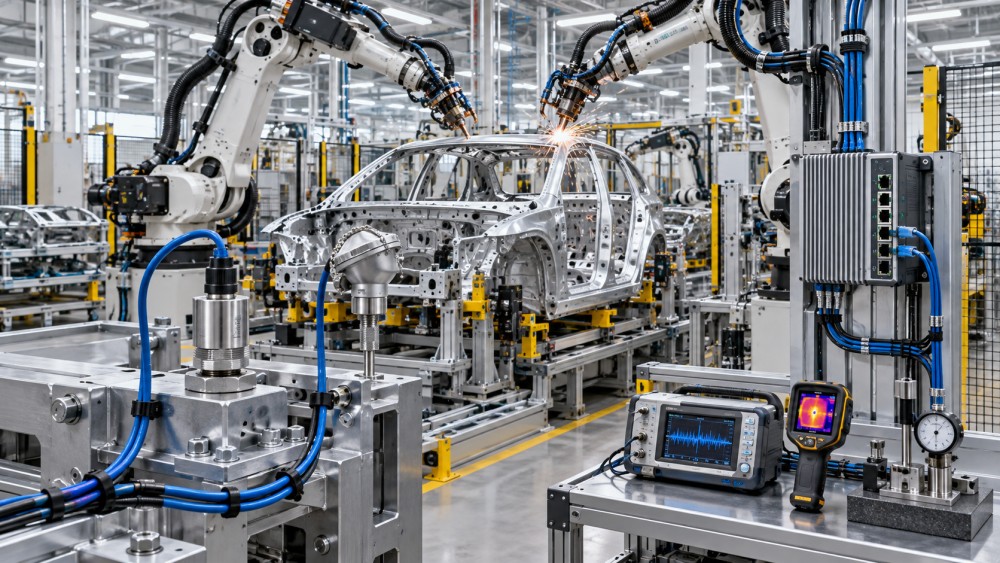
On the shop floor, digital monitoring is usually a chain: sensor or controller, cable or wireless connection, gateway, edge computer, database or cloud service, dashboard, and operator response. A weakness at any point can distort the final picture. The dashboard may look polished while the data behind it is incomplete.
This is especially relevant in the “last mile” of manufacturing, where joining, fastening, inspection, and manual tool use decide whether a component can move forward. A welding current record that drops out during a critical pass, a caliper connected to the wrong job number, or a smart torque tool with an outdated configuration can create traceability gaps that are difficult to reconstruct later.
For that reason, experienced plants do not assess system health solely by asking whether the screen is online. They ask more practical questions: Are the signals believable? Are timestamps consistent? Are devices still associated with the correct assets? Can someone retrieve the records needed for a quality review? And if the system stops reporting, who notices first?
Sensor inspection and calibration: where data quality starts
Sensors require the most hands-on attention because they live in the harshest conditions. Heat, weld spatter, metal dust, coolant mist, vibration, cable flexing, electromagnetic interference, and accidental impact all affect performance. Even a sensor that has not technically failed can drift enough to make trend analysis misleading.
Maintenance should begin with simple visual checks. Look for loose mounts, damaged connectors, crushed cables, contaminated lenses, corroded terminals, and sensor positions that have changed after tool changeovers or fixture adjustments. In a welding area, protective covers and cable routing deserve particular attention. In metrology stations, cleanliness and handling discipline matter more than people sometimes expect; a measuring device can be electrically connected and still produce questionable process data if its physical measurement condition is poor.
Calibration needs a planned approach rather than a universal interval. Some measurements are directly tied to product acceptance or safety-critical assembly requirements and should follow the applicable quality procedure, customer requirement, equipment maker guidance, or local standard. Other signals are used mainly for operational trend monitoring and may justify a different verification schedule. Treating every sensor identically wastes effort; treating all of them as “set and forget” creates a bigger risk.
A useful discipline is to keep a calibration and verification register that links each digital signal to its physical device, location, function, last check, next review, and responsible owner. When a value changes unexpectedly, the team should be able to determine whether the process changed or the measurement system did.
Comparing reactive fixes with preventive digital maintenance
Factories often begin with reactive support: a dashboard is repaired when it goes blank, a gateway is restarted when data stops arriving, and a sensor is replaced after an obvious failure. This may be acceptable for a small pilot, but it becomes expensive once monitoring data informs production decisions, maintenance scheduling, traceability, or customer reporting.
The strongest programs normally combine all three. A failed industrial Ethernet switch still needs an immediate repair. Sensors and enclosures still need scheduled inspection. But the monitoring system should also watch its own health: communication latency, missing data packets, device battery status, storage capacity, synchronization errors, and unusual signal patterns.
That last point is often overlooked. If a torque trace suddenly becomes perfectly flat across many cycles, the process may not have become flawless. The signal channel may be frozen. If a welding station reports identical cycle time for every part over a full shift, it is worth checking whether the event logic is still working. “Too clean” data can be as suspicious as chaotic data.
Network and edge-device upkeep cannot be left to chance
Factory connectivity is different from office connectivity. Network hardware may sit near electrical noise, moving equipment, dust, temperature variation, and shift-based operational changes. Wireless devices can be affected by new racks, temporary barriers, vehicle traffic, or additional machinery. A connection that worked during commissioning may become unreliable after the layout evolves.
Routine maintenance should include checking gateway status, switch health, power supplies, UPS condition where used, cable strain relief, antenna placement, and available network capacity. It also means documenting network changes. Adding a new machine, replacing a controller, changing an IP address, or moving a gateway without updating the asset map can create hours of avoidable troubleshooting.
Edge computers require similar care. Confirm that storage is not filling up, log files are managed, time synchronization is functioning, and restart procedures are known. Many traceability problems are actually timestamp problems: production records arrive, but their sequence becomes difficult to interpret because clocks on controllers, gateways, and servers do not agree.
Software updates should be controlled, not postponed forever
Software maintenance includes dashboard updates, operating system patches, database housekeeping, device firmware, API connections, and backup validation. None of these should be applied casually to an active production environment. A firmware update that improves one device may alter a protocol setting, interrupt a legacy integration, or change how alarms are handled.
The sensible approach is controlled change management. Record the current configuration, identify the affected assets, back up relevant settings and data, test where possible, and schedule deployment around production requirements. After the change, verify not only that the device reconnects, but also that it sends the right data fields and alarms to the correct destination.
Postponing every update is not a safer strategy. Unsupported software, unpatched remote access tools, and unmanaged user accounts can create operational and cybersecurity exposure. The right question is not “Should we update?” but “What is the tested, approved path to update without compromising the process?”
Cybersecurity maintenance is operational maintenance
As more welding cells, precision instruments, hydraulic equipment, and assembly tools become connected, cybersecurity moves closer to the production floor. Monitoring platforms often collect valuable operating data and may connect across IT and operational technology environments. Access control therefore needs regular review.
Remove accounts when employees, contractors, or service providers no longer need access. Review who can change alarm thresholds, edit equipment identities, export records, or remotely access gateways. Use unique credentials and avoid leaving shared service passwords undocumented. Backups should be checked for recoverability, not merely confirmed as “completed.” A backup that cannot be restored during an outage is not much of a backup.
For globally distributed operations, access rules may also be shaped by customer obligations, export restrictions, or regional data-handling requirements. Those details vary by project and jurisdiction, so they should be verified with the organization’s legal, IT, and security teams rather than assumed from a generic platform setting.
The dashboard itself needs periodic questioning
A monitoring system can remain technically healthy while becoming operationally irrelevant. This happens when dashboards accumulate abandoned KPIs, alerts are never acted upon, or a line has changed but its digital model has not. Maintenance therefore includes reviewing whether each monitored signal still has a decision attached to it.
Ask supervisors, maintenance technicians, quality personnel, and operators which alerts they trust and which they ignore. If an alarm produces no useful action, its threshold, escalation logic, or underlying measurement may need revision. If operators repeatedly use manual notes to explain what the system cannot capture, that is valuable feedback for the next configuration update.
This is one reason industrial intelligence should connect engineering knowledge with commercial and operational context. Platforms such as the Global Precision Tools & Welding Matrix follow developments in intelligent torque control, handheld laser welding safety, brushless tool performance, and precision metrology because the technology story is never only about devices. Adoption succeeds when data reliability, workflow design, tool ergonomics, service capability, and production economics are considered together.
Build a maintenance routine around criticality, not habit
Not every connected asset deserves the same maintenance effort. Start by classifying signals according to the consequence of bad or missing data. A display showing general energy trends may tolerate a short interruption. A monitoring channel used to support a controlled fastening operation, a dimensional release decision, or a welding quality record deserves faster detection, clearer ownership, and tighter verification.
A practical routine usually includes shift-level checks for obvious alarms and communication losses; periodic inspection of physical devices and network hardware; scheduled calibration or verification according to the measurement’s purpose; controlled software and firmware review; and a regular audit of user access, backups, data completeness, and dashboard relevance. The exact frequency should reflect process risk, environmental severity, supplier guidance, and the plant’s own maintenance capacity.
Digital factory monitoring does not eliminate maintenance work. It makes maintenance more visible—provided the monitoring layer is maintained with the same discipline expected of the equipment it measures. When data cannot be trusted, smart manufacturing quickly becomes expensive guesswork. When sensors, networks, records, and users are managed as one system, the digital layer becomes a dependable part of everyday production control.
Related News

How to Compare Calibration Tools: Range, Uncertainty, and Traceability
Explore product comparison resources for calibration tools. Compare range, uncertainty, and traceability to choose confidently and support defensible measurement decisions.
Choosing Industrial Metrology Tools: Matching Measurement Uncertainty to Tolerances
Improve industrial tool selection for metrology by matching measurement uncertainty to tolerances. Learn how to reduce inspection risk and choose equipment with confidence.
Torque System Suppliers: How to Assess References for Assembly Projects
Explore supplier and solution references torque systems buyers should verify. Assess assembly fit, traceability, and support to reduce risk and choose with confidence.
Equipment Application Guidance for the Middle East: Managing Heat and Dust
Explore application guidance Middle East teams can use to manage heat and dust, protect welding equipment, batteries and precision tools, and reduce downtime. Get practical tips.
Choosing a Handheld Laser Welding Supplier: Weld Trials, Training, and Service
Choose a handheld laser welding supplier with proven weld trials, safety training, and reliable service. Learn what to verify before buying to reduce downtime and protect your investment.
Choosing an Industrial IoT Platform: Key Criteria for Legacy Equipment
Choose an industrial IoT platform for legacy equipment with confidence. Discover key checks for connectivity, data integrity, security, and lifecycle costs before investing.

In-House vs. Outsourced Aircraft Maintenance: Comparing Total Costs
Compare aerospace maintenance cost for in-house vs. outsourced aircraft upkeep. Discover hidden expenses, downtime impacts, and break-even factors to find the best fit for your fleet.
How to Select High-Precision Measuring Instruments for Tight-Tolerance Production?
High-precision measuring instruments are essential for tight-tolerance production. Learn how to evaluate accuracy, repeatability, environment, calibration, and data integration.
How Industrial Innovation Supplier Networks Reduce Sourcing Risk for Manufacturers
industrial innovation supplier network insights help manufacturers reduce sourcing risk, control lifecycle costs, and choose reliable tools, services, and suppliers with confidence.
Related News
- 00
0000-00
Equipment Application Guidance for the Middle East: Managing Heat and Dust - 00
0000-00
Choosing an Industrial IoT Platform: Key Criteria for Legacy Equipment - 00
0000-00
How to Select High-Precision Measuring Instruments for Tight-Tolerance Production? - 00
0000-00
How Do Advanced Manufacturing Methods Improve Batch Consistency? - 00
0000-00
What Maintenance Do Digital Factory Monitoring Systems Need?
Prof. Marcus Chen
Weekly Insights
Stay ahead with our curated technology reports delivered every Monday.