
PCB Prototyping Equipment Costs: Comparing In-House Machines and Outsourced Builds





A PCB prototype should be evaluated as a sequence of costs rather than a board price or a machine quotation. The relevant comparison begins with the capital tied up in equipment, then follows through engineering labor, consumables, scrap, inspection, outside services, and the cost of waiting for a revised board. An in-house setup can shorten early design loops, while outsourced fabrication can provide layer registration, plated vias, controlled impedance, and finishing processes that a benchtop system cannot reproduce economically. The lower-cost route changes with board complexity and the number of design iterations.
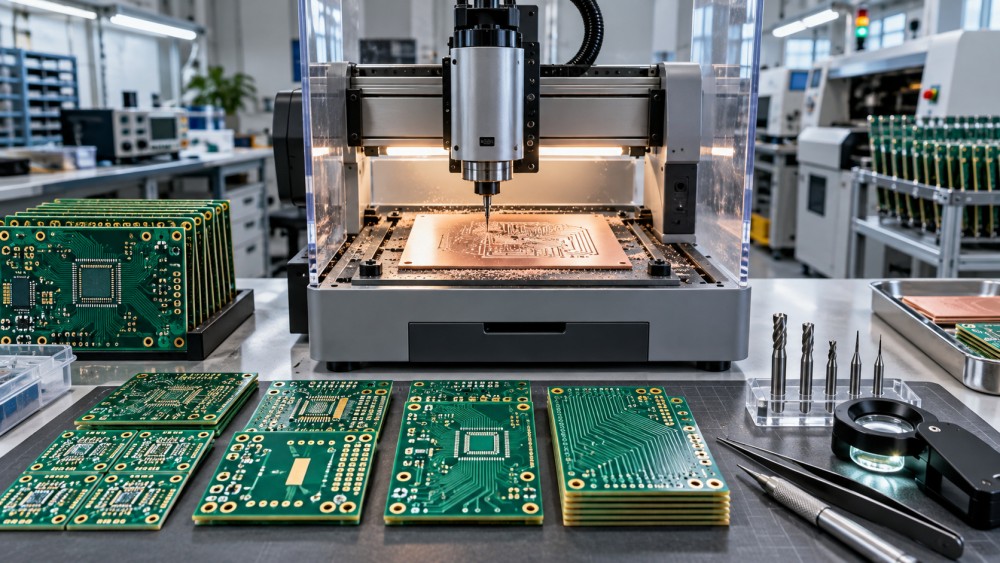
For simple single- or double-sided circuits, a desktop milling or routing system can appear attractive because it turns a layout revision into a physical board without a purchase order, production queue, or courier transit. That advantage is real when the design needs repeated mechanical fit checks, connector placement verification, or low-voltage functional testing. It becomes less compelling when the board needs fine-pitch components, dense routing, reliable through-hole interconnection, solder mask, or a production-like surface finish.
Separate the Purchase Price from the Cost of Capability
The first quotation for PCB prototyping equipment rarely represents the full capital requirement. A usable in-house process usually includes the machine, computer and design-file workflow, tool inventory, material storage, dust extraction, workholding, inspection equipment, soldering and rework tools, and a suitable work area. Chemical etching introduces further requirements for ventilation, handling, waste management, and process control. These adjacent costs are not optional if the objective is repeatable boards rather than occasional experimental pieces.
A milling machine also has a practical capability envelope. Track width and isolation clearance depend on spindle runout, cutter diameter, board flatness, copper adhesion, tool wear, and the consistency of the depth reference. A specification stating a fine nominal feature does not guarantee that every footprint on a dense board can be produced at that feature. The useful question is whether the machine can reliably produce the smallest trace, clearance, pad geometry, and hole pattern found in the actual design, with a margin for setup variation.
Outsourced builds package many capabilities into the fabrication price: multilayer lamination, drilled and plated holes, solder mask registration, silkscreen, finish selection, electrical test options, panel handling, and controlled stackups where required. Comparing that price only against bare laminate and cutter consumption understates the cost of reproducing those functions internally. A board with plated through holes is a common dividing line. Drilling a hole locally is straightforward; making it a dependable electrical connection between layers requires a much more controlled process.
Model Cost by Revision Cycle, Not by Board Alone
Prototype programs consume boards in cycles: layout release, assembly, test, fault isolation, redesign, and another release. The first board is rarely the economic unit that matters. A local machine can reduce elapsed time between these stages, but its value depends on whether the organization can act on that speed. If firmware, component availability, test fixtures, or mechanical parts will delay the next test anyway, an overnight board does not create an equivalent schedule gain.
A useful internal model assigns a cost to each completed learning cycle. Include direct board material, consumables, machine time, setup and cleanup labor, inspection, manual assembly adjustments, and the expected cost of remaking failed boards. For an outsourced order, include fabrication, shipping, order administration, expedited service when used, incoming inspection, and the calendar delay before the board can enter testing. This does not require speculative market benchmarks. It requires consistent internal assumptions applied to both paths.
Machine utilization is often overestimated because planned prototype volume is confused with suitable prototype volume. A team may produce many boards each year while only a fraction are simple enough for local fabrication. Boards requiring four layers, blind or buried vias, BGA escape routing, impedance control, edge plating, castellations, heavy copper, flexible substrates, or tightly registered solder mask should not be counted as demand that justifies a basic in-house machine. Count only the work that will actually pass through the equipment without compromising the test objective.
There is also a difference between a board used to answer one question and a board used to validate a design. A locally milled board may be sufficient to confirm whether a sensor reads, a connector aligns with an enclosure, or a power stage begins switching. It may be unsuitable for checking high-speed signal integrity, electromagnetic behavior, thermal performance of production copper patterns, or assembly yield around fine-pitch packages. Treating a convenience prototype as a production-representative sample can create a false saving followed by a later redesign.
Where In-House Fabrication Adds Friction
Local fabrication shifts work from an external supplier to internal technical staff. That shift is sometimes overlooked because the labor is not shown on the machine invoice. Files must be prepared for the machine, origin points set, boards secured, cutting depths calibrated, and the output inspected before assembly. A small error in copper isolation may appear only after solder bridges, intermittent connections, or a failure under load. When several people share the equipment, job scheduling, material replenishment, cleaning, and maintenance also become recurring operating tasks.
Tooling consumption is not merely a small variable charge. Fine cutters dull or break, especially when board flatness and depth control are imperfect. A worn bit can leave narrow copper bridges that are difficult to see but sufficient to corrupt a measurement. Drills can wander or fracture, and poor backing support can damage hole quality. Consumables should therefore be budgeted with a scrap allowance tied to the most delicate feature being produced, rather than to average board area alone.
Process repeatability matters when a test result will influence a larger release decision. Uneven copper removal, hand-applied solder mask substitutes, jumpers, and manually inserted via wires can change parasitic resistance, capacitance, and inductance. Those differences may be irrelevant in a low-frequency interface board yet material in switching power, radio-frequency, precision analog, or fast digital work. The prototype method must be compatible with the question being asked of the circuit.
Outsourcing Costs That Are Easy to Understate
External fabrication is not automatically the low-administration option. A release package needs clear fabrication notes, drill files, layer naming, board outline, stackup instructions where applicable, assembly drawings, and a bill of materials that matches the design revision. Ambiguity may lead to a clarification request, an incorrect assumption, or a board that is technically built to file but unusable in assembly. A concise pre-release review reduces this risk, particularly where slots, cutouts, impedance requirements, copper weights, and finish requirements are involved.
Shipping affects more than freight cost. A low-value prototype delayed in transit can idle a lab schedule, while expedited shipping can erase the apparent saving of a slower fabrication route. Consolidating boards into a larger order lowers unit freight but can delay a design that is ready today. The correct comparison should use the expected timing of the individual program, not the lowest available shipping rate in isolation.
Minimum order quantities and panel economics create another distortion. A fabrication house may supply several boards when only one is immediately needed. The surplus has value if it supports parallel testing, destructive analysis, or a second assembly attempt. It has little value if the design is likely to change before those boards are used. Excess prototype inventory should not automatically be treated as an asset at full purchase cost.
Complexity Triggers That Change the Decision
Several design features should move the analysis toward external fabrication unless there is a specialized internal process already in place. Plated through holes are one trigger because they affect routing density and mechanical reliability. Fine-pitch leadless packages and ball-grid arrays are another, as pad geometry, solder mask definition, and surface finish influence assembly quality. Multilayer boards bring lamination alignment, dielectric thickness, and interlayer registration into the result. High-current designs may need defined copper weight, thermal relief geometry, and controlled drilling around mounting features.
Signal-sensitive boards deserve separate treatment. Differential pairs and controlled-impedance traces are defined by the trace geometry and the finished stackup together. Copying the visible trace width onto a single-sided milled board does not preserve the electrical environment of a multilayer production design. Similarly, a power converter tested on a locally improvised layout can behave differently because loop area, copper thickness, and return-current paths have changed. Such boards may still benefit from a quick local proof of concept, but the result should be labeled as preliminary rather than treated as final validation.
Choosing a Mixed Model Without Double Counting
Many development groups benefit from using local fabrication for early learning and external builds for design verification. The division should be defined by the purpose of the board, not by habit. Simple adapter boards, mechanical templates, breakout boards, and early interface experiments are strong candidates for internal work. Boards used for regulatory pre-compliance, thermal characterization, high-speed testing, customer samples, or assembly-process confirmation generally need fabrication closer to the intended production method.
The mixed model only works when version control is disciplined. A locally modified board can easily diverge from the source layout through cut traces, added wires, swapped components, and handwritten changes. Record every modification that changes the observed behavior. Otherwise, a later outsourced revision may remove the very change that made the local prototype function, creating a misleading failure and another purchase cycle.
Approval should therefore be tied to an explicit operating boundary: the board types that will be fabricated internally, the capabilities that remain external, the annual volume assumed for equipment utilization, and the labor and maintenance costs assigned to the process. Revisit that boundary when design complexity, release frequency, or available technical capacity changes. The most economical choice is the one that produces reliable learning at the needed speed without carrying unused capability or treating an unrepresentative prototype as proof of a finished design.
Related News

In-House vs. Outsourced Aircraft Maintenance: Comparing Total Costs
Compare aerospace maintenance cost for in-house vs. outsourced aircraft upkeep. Discover hidden expenses, downtime impacts, and break-even factors to find the best fit for your fleet.

How to Select High-Precision Measuring Instruments for Tight-Tolerance Production?
High-precision measuring instruments are essential for tight-tolerance production. Learn how to evaluate accuracy, repeatability, environment, calibration, and data integration.
How Industrial Innovation Supplier Networks Reduce Sourcing Risk for Manufacturers
industrial innovation supplier network insights help manufacturers reduce sourcing risk, control lifecycle costs, and choose reliable tools, services, and suppliers with confidence.

South East Asia Machine Tools Market: Demand Outlook by Manufacturing Industry
South East Asia machine tools market outlook: explore demand from automotive, electronics, fabrication, and infrastructure, plus smart sourcing priorities for manufacturers.
Which Industrial Standards Should Be Checked Before Export?
Which industrial standards should be checked before export? Discover essential compliance steps for industrial tools, welding equipment, laser systems, and metrology products.

What Industrial Automation Exporters Need to Know Before Entering ASEAN Markets
Industrial automation exporter to ASEAN: learn how to navigate compliance, local service, digital readiness, pricing, and market entry for scalable growth.
Prototype PCB Manufacturing Equipment: What Engineers Should Evaluate Before Purchase
Prototype PCB manufacturing equipment: discover the key factors engineers should evaluate—from accuracy and materials to software, safety, and ROI—before buying.

Workplace Ergonomics for Manufacturing: Reducing Repetitive-Strain Risks on Assembly Lines
Workplace ergonomics for manufacturing helps reduce repetitive-strain risks on assembly lines through smarter workstation design, tool selection, task analysis, and quality-focused improvements.

Selecting Adjustable Torque Tools for Repeatable Fastener Assembly
Adjustable torque tools: learn how to match range, accuracy, control methods, calibration, and ergonomics for repeatable, reliable fastener assembly.
Related News
- 00
0000-00
PCB Prototyping Equipment Costs: Comparing In-House Machines and Outsourced Builds - 00
0000-00
Why Data-Driven Intelligence Costs Are Reshaping Enterprise Automation Budgets - 00
0000-00
What Does Data-Driven Intelligence Cost? Budgeting for Data, Tools, and Talent - 00
0000-00
What Determines Metrology Technology Prices for Factory Inspection Systems? - 00
0000-00
Welding Tools Price Guide: What Affects Cost and How Buyers Can Compare Options
Ms. Elena Rodriguez
Weekly Insights
Stay ahead with our curated technology reports delivered every Monday.